Caoimhin
Dark Lies the IslandCaoimhin’s flight from the city leads him to an old hotel on Killary Fjord, where a flood crisis tests his hopes of escape. The novel presents him as both an outsider among the locals and a man confronting, at forty, the exhaustion and uncertainty he had hoped a change of place would relieve; his response to rising waters becomes a defining commitment to acceptance.
Identity and Background
Caoimhin has made a life for himself, but the year he turned forty he felt exhaustion gathering and found it increasingly difficult to spend whole days alone with his work. The city had become an irritant, not least because of the abundance of young people around him. The hotel brochure offered a way out: he kept it close for days, became feverish with the idea of moving west, and read its promises of original beams and a traditional coaching inn as invitations to another life.
He bought the old hotel beside the harbour wall on Killary Fjord. Across the water stood Mweelrea mountain; the skies were disgracefully grey, and rain fell 287 days of the year. Eight months into his stay, Caoimhin was already close to believing the place would be his undoing. His move had answered the city’s pressure with a setting whose weather and isolation brought their own strain.
Life Among the Locals
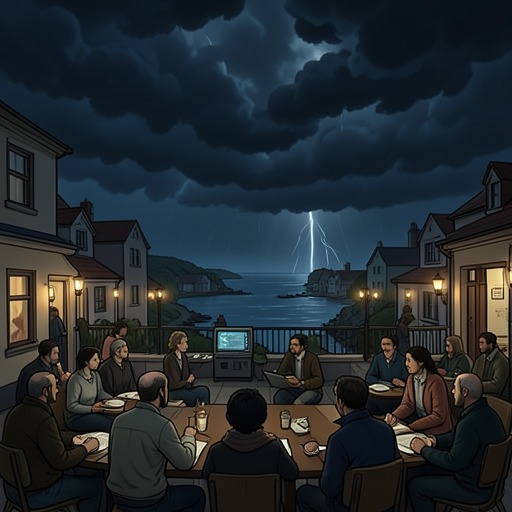
Caoimhin’s position in the hotel is that of a fretful newcomer. During the violent storm, he calls the conditions the end of the world, but the lounge-bar regulars ignore him as they habitually do. They regard him as a blow-in unsuited to the tough life of the west of Ireland, while giving their attention instead to John Murphy, the local alcoholic funeral director.
His exchanges with Bill Knott reveal a further contrast between Caoimhin’s perspective and the locals’ interests. Bill presses him to estimate how long a journey to Belmullet might take, weighing the slow road, a possible tailback out of Newport, and the route from Westport. Caoimhin cannot provide the estimate Bill seeks and finally answers that they might as well be swimming. The conversation captures his irritation with the local preoccupation with distances and road times, as well as his difficulty finding common ground in the community he has joined.
Crisis and Acceptance
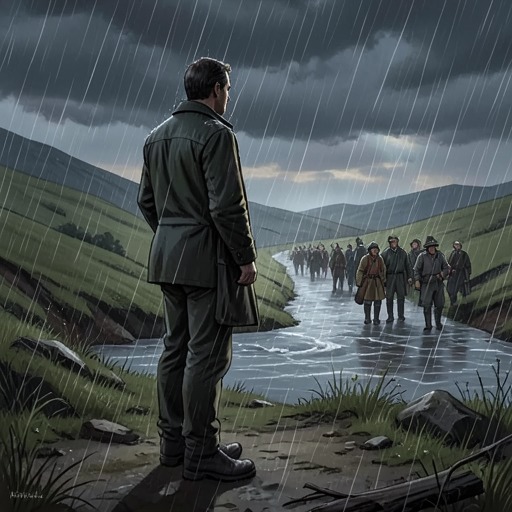
As the waters continue to rise, no rescuers in high-visibility clothing appear. Caoimhin’s perception shifts: the unfolding danger makes the world’s harsh possibilities suddenly clear. At forty, he concludes that he must learn acceptance, giving the idea the force of a named principle. He resolves to accept whatever comes, whether a watery death in Ireland’s only natural fjord, a return to the city, exile elsewhere, the presence or absence of poems and children, love, illness, or success.
The resolve does not amount to a promise that the crisis will be safely overcome. Rather, Caoimhin makes acceptance his response to outcomes he cannot control, extending the decision beyond the immediate flood to the rest of his life. The moment links his earlier search for a new beginning to a less romantic recognition: changing location cannot guarantee relief from uncertainty, and the life ahead may include both what he wants and what he fears.